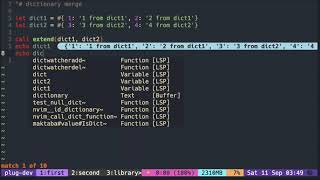
Web Reference: " Merge two dictionaries, also recursively merging nested keys. " Use extend() if you don't need to merge nested keys. let l:new = copy(a:defaults) for [l:k, l:v] in items(a:override) let l:new[l:k] = (type(l:v) is v:t_dict && type(get(l:new, l:k)) is v:t_dict) \ ? s:merge(l:new[l:k], l:v) \ : l:v. endfor. return l:new. Instead of you can use . . The last type of Vimscript variable we'll talk about is the dictionary. Vimscript dictionaries are similar to Python's dicts, Ruby's hashes, and Javascript's objects. To merge in multiple entries from another dictionary, use the extend() function. Both the first argument (which is being extended) and the second argument (which contains the extra entries) must be dictionaries:
YouTube Excerpt: You can see that it overrided the value with that of the second the value of
Information Profile Overview
Vimscript Tutorial Dictionary Merge 2 - Latest Information & Updates 2026 Information & Biography
Details: $35M - $44M
Salary & Income Sources

Career Highlights & Achievements


Assets, Properties & Investments
This section covers known assets, real estate holdings, luxury vehicles, and investment portfolios. Data is compiled from public records, financial disclosures, and verified media reports.
Last Updated: April 6, 2026
Information Outlook & Future Earnings

Disclaimer: Disclaimer: Information provided here is based on publicly available data, media reports, and online sources. Actual details may vary.