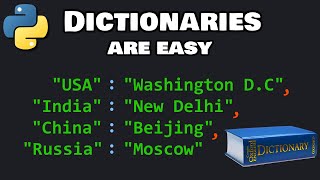
Web Reference: In this tutorial, you’ll explore how to create dictionaries using literals and the dict() constructor, as well as how to use Python’s operators and built-in functions to manipulate them. Dictionary Dictionaries are used to store data values in key:value pairs. A dictionary is a collection which is ordered*, changeable and do not allow duplicates. As of Python version 3.7, dictionaries are ordered. In Python 3.6 and earlier, dictionaries are unordered. Dictionaries are written with curly brackets, and have keys and values: Oct 9, 2023 · This article contains 13 Python dictionary examples with explanations and code that you can run and learn with! Dictionaries are one of Python’s most fundamental data types; they are widely used to represent real-world data and structures.
YouTube Excerpt: Python Tutorial
Information Profile Overview
Python Tutorial 13 Dictionary In - Latest Information & Updates 2026 Information & Biography

Details: $6M - $46M
Salary & Income Sources
Career Highlights & Achievements


![Celebrity [Python 13]: Dictionaries in Python: A Complete Guide for Beginners & Experts Wealth](https://i.ytimg.com/vi/B4d0-5nZ_h4/mqdefault.jpg)


![#13 Python Tutorial - Dictionary in Python - Python for Beginners [2020] Full Course Net Worth](https://i.ytimg.com/vi/Ptego1ecoho/mqdefault.jpg)

Assets, Properties & Investments
This section covers known assets, real estate holdings, luxury vehicles, and investment portfolios. Data is compiled from public records, financial disclosures, and verified media reports.
Last Updated: April 5, 2026
Information Outlook & Future Earnings
Disclaimer: Disclaimer: Information provided here is based on publicly available data, media reports, and online sources. Actual details may vary.