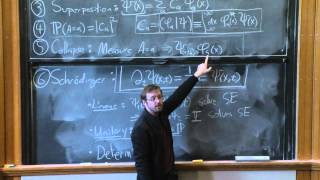
Web Reference: The formula is provided below. Particularly if a time-independent operator commutes with the Hamiltonian, its expectation value is constant with time (in other words, it corresponds to a constant of motion). We then explore two specific examples of time evolution in two-state problems. To describe dynamical processes, such as radiation decays, scattering and nuclear reactions, we need to study how quantum mechanical systems evolve in time. The evolution of a closed system is unitary (reversible). The evolution is given by the time-dependent Schr ̈odinger equation. We argue that there are two physically equivalent ways to formulate “textbook” quantum mechanics with unitary time evolution. Under one formulation, the unitarity of time evolution does follow naturally from the other postulates of QM and the assumption of linear time-evolution.
YouTube Excerpt: We're gonna finish our discussion of the rules of quantum mechanics by turning to rule seven
Information Profile Overview
The Time Evolution Rule - Latest Information & Updates 2026 Information & Biography

Details: $74M - $112M
Salary & Income Sources

Career Highlights & Achievements





Assets, Properties & Investments
This section covers known assets, real estate holdings, luxury vehicles, and investment portfolios. Data is compiled from public records, financial disclosures, and verified media reports.
Last Updated: April 5, 2026
Information Outlook & Future Earnings
Disclaimer: Disclaimer: Information provided here is based on publicly available data, media reports, and online sources. Actual details may vary.